


Endress+Hauser Electronic Differential Pressure Deltabar FMD71 / FMD72
1. Positioning & Core Value
The Deltabar FMD71 and FMD72 form an electronic differential pressure (EDP) measurement system developed by Endress+Hauser, specifically designed for liquid level, volume, and mass measurement in pressurized or vacuum vessels. Their core value lies in replacing traditional mechanical differential pressure methods (such as impulse lines and capillary tubes) with an advanced electronic architecture, effectively eliminating many long-standing operational issues.
The system delivers higher process reliability and safety while significantly reducing total cost of ownership.
2. System Architecture & Operating Principle
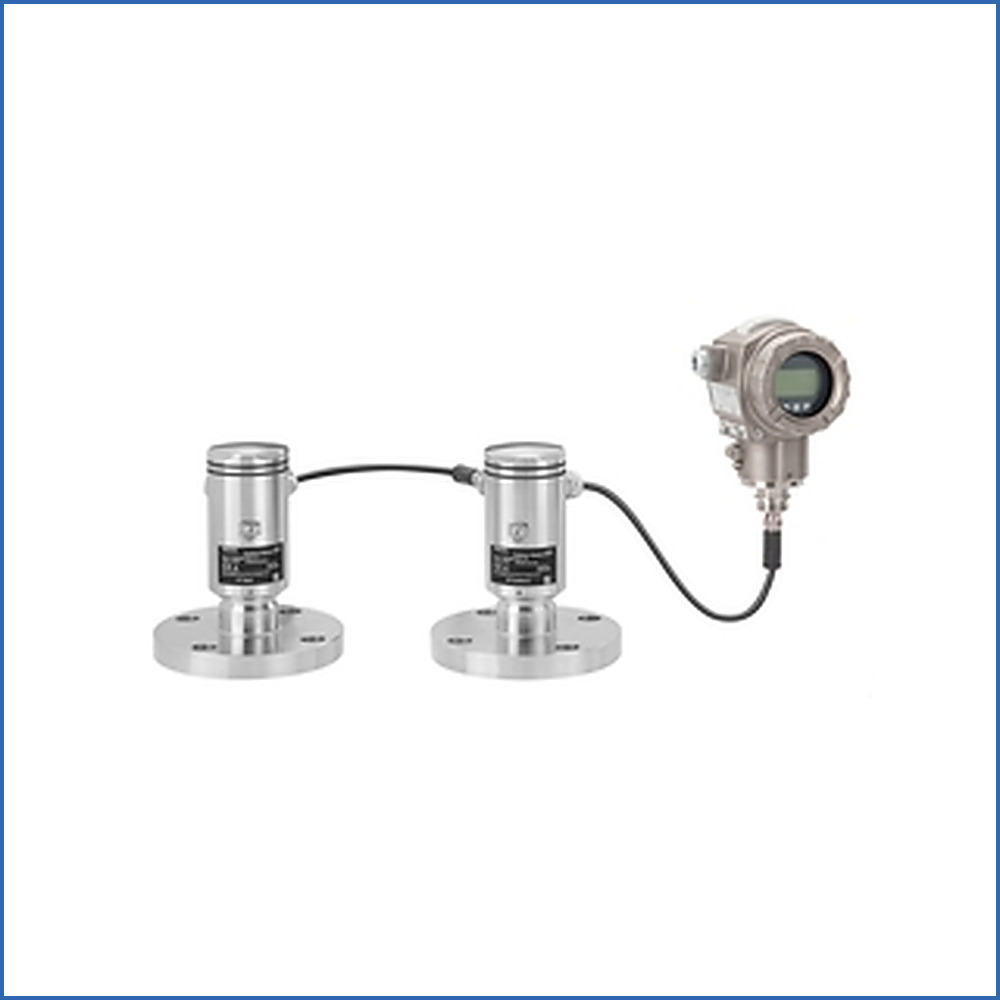
Unlike conventional integrated DP transmitters, the FMD71/FMD72 is a modular system consisting of three main components:
-
Two sensor modules – installed at the high-pressure (HP) side (measuring hydrostatic pressure) and the low-pressure (LP) side (measuring vessel top pressure).
-
One transmitter – receives digital signals from both sensors, calculates the differential pressure internally (HP value minus LP value), and outputs a 4…20 mA HART signal.
By subtracting the top pressure from the total hydrostatic pressure, the system effectively cancels out the influence of pressure fluctuations above the liquid surface, delivering a true net level reading.
3. Model Differentiation & Sensor Technology
The primary difference between the FMD71 and FMD72 lies in their sensor technologies, catering to different application requirements:
| Model | Sensor Type | Key Features | Typical Applications |
|---|---|---|---|
| FMD71 | Ceramic (Ceraphire®) | Dry measurement (oil-free); extremely high corrosion and abrasion resistance; absolute vacuum tolerance; high overpressure capability (up to 40× range). | Vacuum applications, highly corrosive media, and processes requiring high medium purity. |
| FMD72 | Metal (silicon-based) | Fully welded metallic isolation diaphragms; high pressure rating; minimal thermal effect. | High-pressure conditions (e.g., distillation columns), steam applications, and processes with elevated process pressures. |
4. Key Performance & Advantages
-
Enhanced reliability and safety – Eliminates common issues found in traditional mechanical systems, such as impulse line clogging, condensation, leakage, and thermal drift caused by ambient temperature changes in capillaries. In one chemical plant distillation application, the FMD72 system operated stably for over 18 months without maintenance, whereas the previous capillary system failed every 4–6 months due to temperature and vacuum issues.
-
High measurement accuracy – Reference accuracy of ±0.075 % per sensor; optional “PLATINUM” version offers an enhanced accuracy of ±0.05 %.
-
Cost efficiency – Standard electrical cabling simplifies installation and maintenance. Individual components can be replaced without recalibration or reconfiguration, reducing spare parts inventory and overall lifecycle costs.
-
Advanced diagnostics – Via HART protocol, the system provides continuous system health status along with multivariable information including differential pressure, individual pressures, and sensor temperature – facilitating predictive maintenance.
5. Key Technical Specifications (Overview)
| Parameter | FMD71 | FMD72 |
|---|---|---|
| Measuring range | 100 mbar up to 40 bar | 400 mbar up to 10 bar |
| Max. process pressure | 60 bar | 160 bar |
| Process temperature | –25…150 °C | –40…125 °C (higher on request) |
| Process connections | Threaded, flanged, and hygienic (Tri-Clamp, DIN11851, etc.) | |
| Approvals | ATEX, FM, CSA, IECEx, and other major international explosion protection certifications |
6. Typical Industries & Applications
The Deltabar FMD71/FMD72 system is widely deployed across the oil & gas, chemical, food & beverage, life sciences, power generation, and metallurgy industries. It excels in demanding applications such as:
-
High distillation columns
-
Evaporators
-
Reactors
-
Storage tanks with fluctuating top pressures
In these complex environments, the system delivers outstanding performance where conventional DP solutions often fall short.
Endress Hauser Electronic Differential Pressure Deltabar FMD71 FMD72
The Deltabar FMD71 and FMD72 form a modular electronic differential pressure (EDP) measurement system developed by Endress+Hauser, specifically designed for liquid level, volume, and mass measurement in pressurized or vacuum vessels. The system consists of two sensor modules (high-pressure side HP and low-pressure side LP) and one transmitter: the HP sensor measures the hydrostatic pressure, the LP sensor measures the top pressure of the vessel, and the transmitter calculates the net differential pressure from the digital signals, effectively eliminating the influence of pressure fluctuations above the liquid surface. Compared with traditional mechanical systems (impulse lines, capillaries), this system fundamentally eliminates issues such as clogging, condensation, leakage, and thermal drift caused by ambient temperature variations.
The core difference between the FMD71 and FMD72 lies in their sensor technologies:
-
FMD71 employs a ceramic sensor (Ceraphire®) : This is a dry measurement principle with no oil filling. Process pressure acts directly on a high-purity ceramic diaphragm (99.9% Al₂O₃), and pressure is detected via capacitance change. Its outstanding features include an overpressure capability of up to 40 times the measuring range, as well as the ability to operate in absolute vacuum conditions (up to 150°C). This makes it particularly suitable for vacuum applications and highly corrosive media.
-
FMD72 employs a metal sensor (silicon technology) : Process pressure is transmitted through a metallic isolation diaphragm and fill fluid to a semiconductor piezoresistive chip. Its fully welded metallic construction can withstand process pressures of up to 160 bar, and its thermal effect is significantly lower than that of conventional diaphragm seal systems. It is ideal for high-pressure distillation columns, steam applications, and elevated process pressures.
Performance and advantages – The reference accuracy of each sensor is ±0.075 %, with an optional “PLATINUM” high-accuracy version offering ±0.05 %; the overall system accuracy can reach ±0.07 %. Long-term stability is rated at 0.05 % URL/year. Via the HART protocol, the system provides continuous health status diagnostics and outputs multivariable information including differential pressure, individual pressures, and sensor temperature, supporting predictive maintenance strategies. Thanks to standard electrical cabling, individual components can be replaced independently without recalibration, significantly reducing installation, maintenance, and spare parts costs.
Key technical specifications:
| Parameter | FMD71 | FMD72 |
|---|---|---|
| Measuring range | 100 mbar to 40 bar | 400 mbar to 10 bar |
| Max. process pressure | 60 bar | 160 bar |
| Process temperature | –25…+150°C | –40…+125°C (optional up to 250°C) |
| Process connections | Threaded, flanged, and various hygienic connections (Tri-Clamp, DIN11851, etc.) | |
| Approvals | ATEX, FM, CSA, IECEx explosion protection; EHEDG and 3A hygienic certifications |
The system is widely used across the oil & gas, chemical, food & beverage, life sciences, power generation, and metallurgy industries. It excels particularly in high distillation columns, evaporators, reactors, and other demanding applications where measurement reliability and accuracy are critical.